
Search Alabama Court Records
Alabama offers broad statewide access to Circuit and District Court data through two official paid services. Just One Look provides on-demand access to one case at a time, while Alacourt is the read-only subscription service for trial case details and available document images. Both cover civil, domestic, criminal, and traffic cases in the state trial system. They do not turn every municipal or probate file into a statewide record. Sealed matters, confidential cases, older paper files, and documents that were never imaged also remain outside public results.
Start with a case number whenever possible. Name searches can produce several people, so confirm the county, court, party role, filing date, and case category before relying on a match. The Alabama Administrative Office of Courts services page identifies the official search, filing, and payment tools. Its interface is shown below as a reference to Alabama's court technology choices.
View the official AOC services source for Alabama court records.
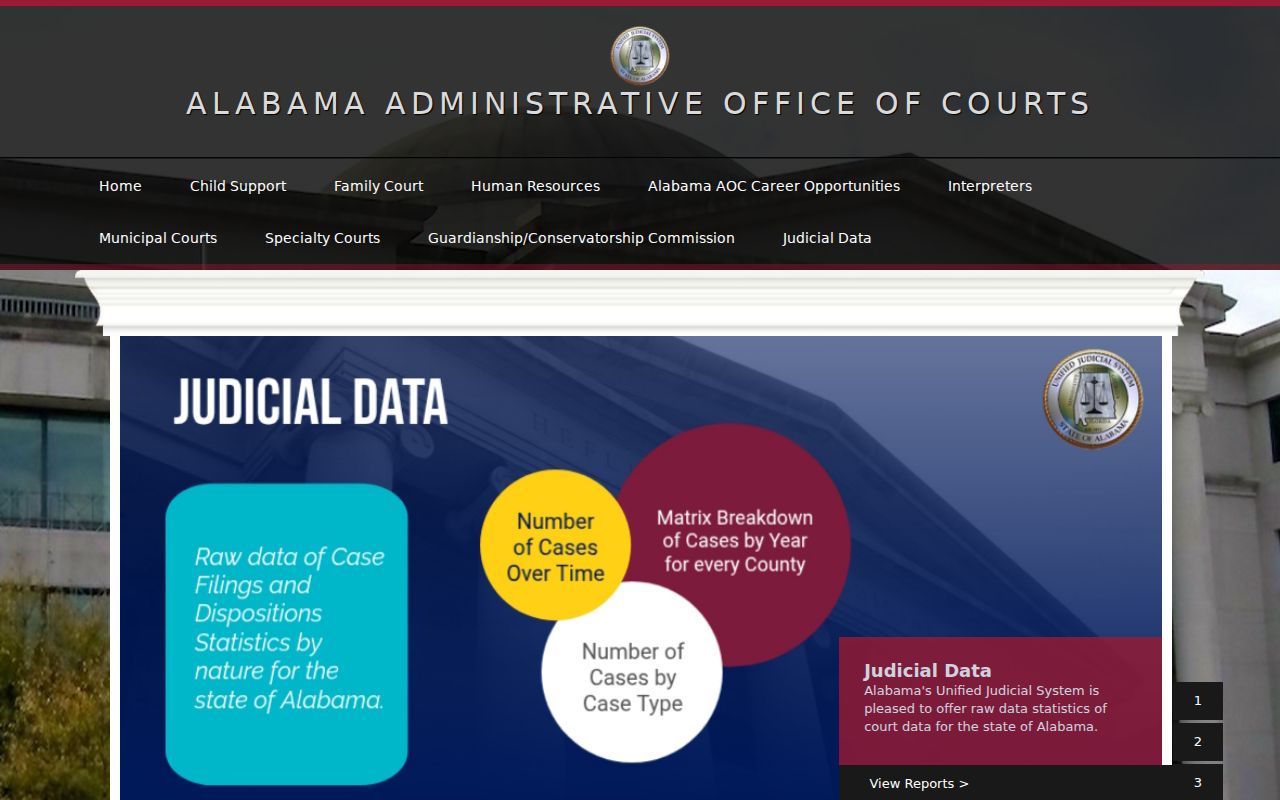
The AOC service menu helps separate public case access from attorney filing and payment functions.
- Identify the venue from the citation, complaint, indictment, petition, or appellate case number. The filing county matters more than a party's current address.
- Use Just One Look or Alacourt for a state Circuit or District Court case. Search by exact case number first, then by a full or variant name if needed.
- Confirm the county, division, parties, and filing date. Read the docket through the final disposition rather than treating the first charge or claim as the outcome.
- For municipal or probate records, go to the city clerk or county probate office. For appellate records, use the separate portal linked by the appellate clerk.
- Request the actual order, pleading, or certified copy from the custodian. An online screen is useful for research but is not an official certified record.
The Just One Look landing screen shows the paid case-by-case route. Open the official Just One Look source to check current registration and access terms.
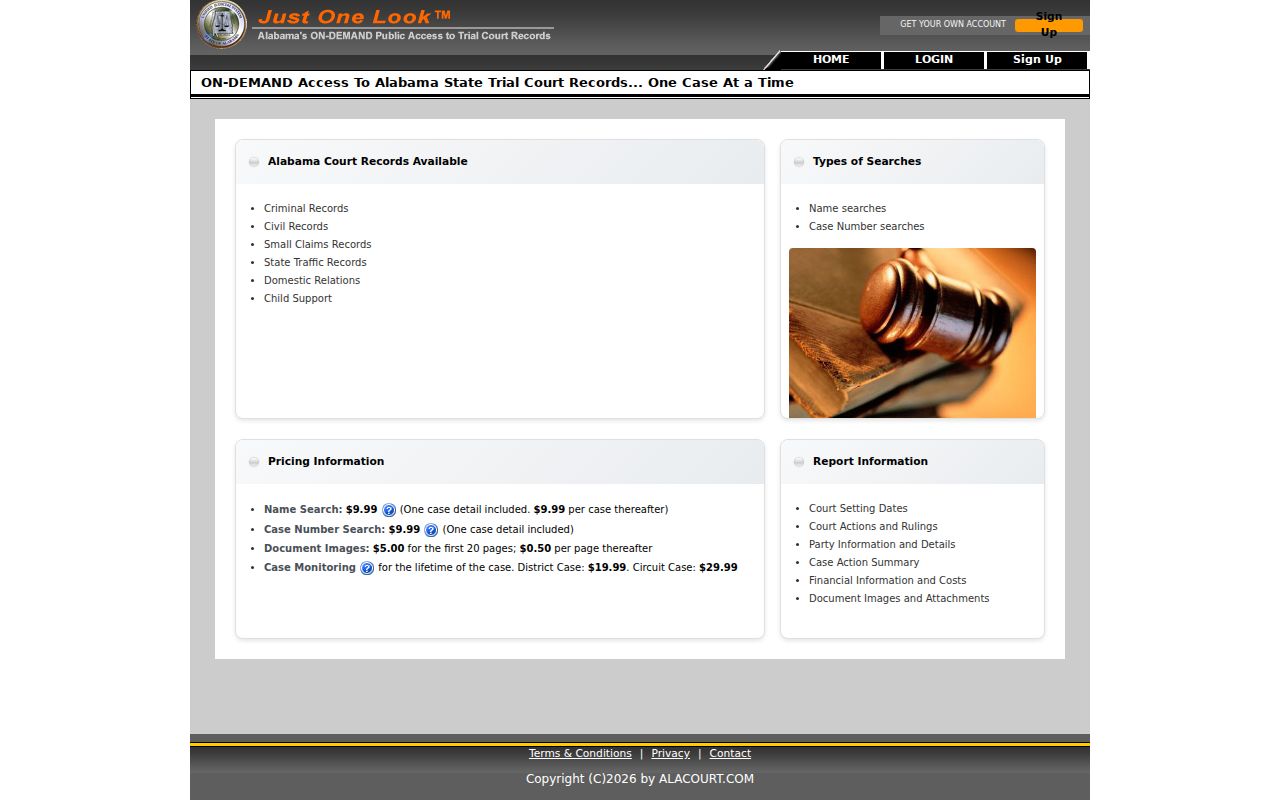
One-case access is useful when the filing court is known, but the county clerk remains the source for missing images and certification.
| Search Field | Use | Search Note |
|---|---|---|
| Case number | Precise case lookup | Use the full county and case-type format shown on the filing. |
| Party name | Broader discovery | Try full and former names, then verify identity from case context. |
| Court or county | Venue check | Confirms which circuit clerk holds the source file. |
| Case category | Result filter | Civil, domestic, criminal, and traffic are identified by the system. |
Inside the Alabama Court System
The Alabama court system is unified for administration, yet custody of records still follows the court that created them. The nine-member Supreme Court of Alabama is the final state court. Two five-judge intermediate courts divide appeals by subject: the Court of Civil Appeals handles domestic relations, workers' compensation, most agency appeals, and lower-value civil appeals, while the Court of Criminal Appeals handles criminal and post-conviction matters. These are statewide subject-matter courts, not two geographic appellate districts.
Circuit Court is Alabama's general-jurisdiction trial court. The state groups all counties into 41 judicial circuits, and each county circuit clerk keeps both Circuit and District Court files. District Court handles limited civil matters, small claims, misdemeanors, felony preliminary proceedings, and some traffic cases. Municipal clerks maintain city ordinance and traffic matters. Each county Probate Court separately holds estates, wills, guardianships, conservatorships, name changes, adoption files, and marriage certificate recordings.
Typical appeals path: District or Municipal Court › Circuit Court trial de novo › subject-matter intermediate appellate court › Supreme Court of Alabama.
| Court | Jurisdiction | Case Types |
|---|---|---|
| Supreme Court of Alabama | Final state review and rulemaking | Civil appeals above the statutory line, Public Service Commission appeals, and discretionary review |
| Civil and Criminal Appeals | Intermediate subject-matter review | Civil, domestic, agency, workers' compensation, criminal, and post-conviction appeals |
| Circuit Court | General trial jurisdiction | Felonies, divorce, larger civil cases, jury trials, and de novo appeals |
| District and Municipal Courts | Limited trial jurisdiction | Misdemeanors, small claims, preliminary felony work, ordinances, and traffic |
| Probate Court | Separate county jurisdiction | Estates, guardianships, conservatorships, name changes, adoption, and marriage recording |
The Alabama Judicial System provides the official statewide court entry point.
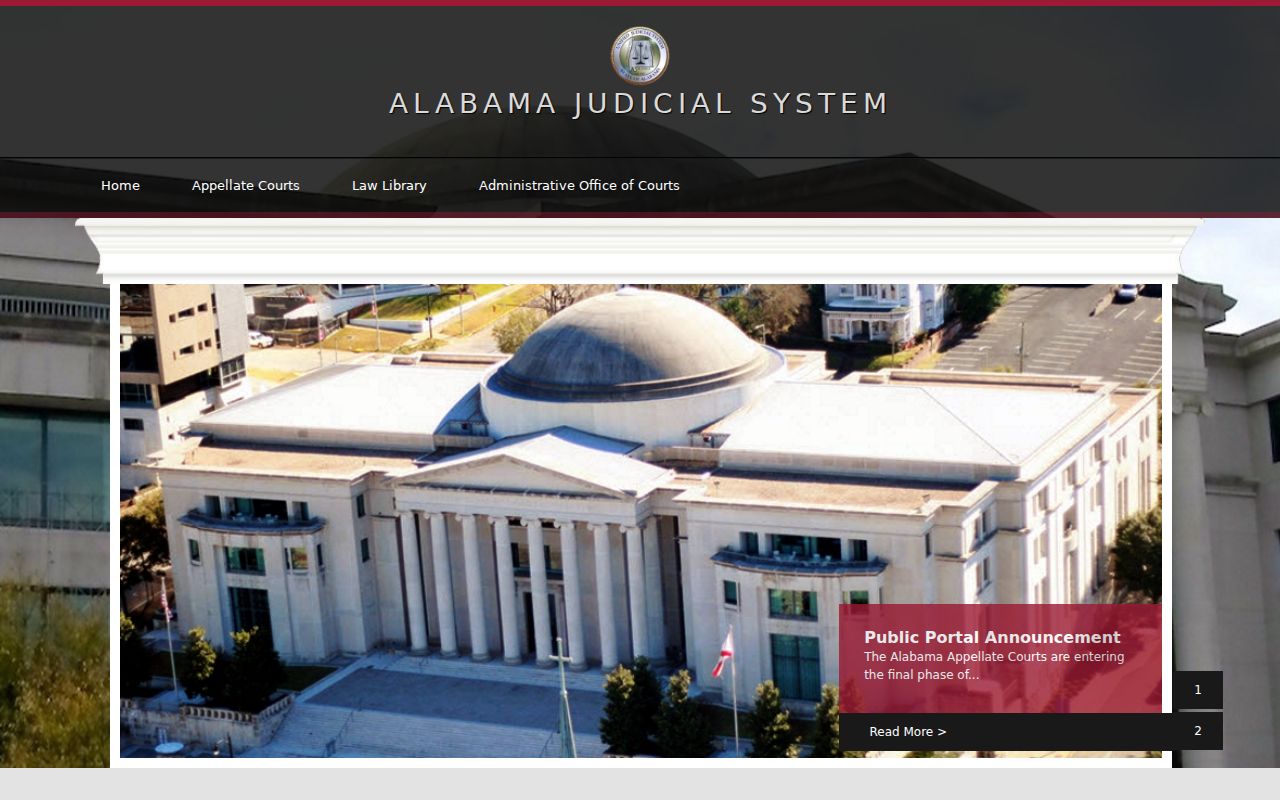
That official site connects the appellate courts, current court rules, directories, and administrative information without replacing the filing county's clerk.
Types of Alabama Court Records
Alabama court records are defined by subject and venue. A Circuit civil file may include a complaint, service, motions, admitted exhibits, orders, judgment, garnishment, and appeal entries. District civil records include small claims, debt, property damage, and landlord-tenant matters within current statutory jurisdiction. Discovery exchanged between parties is not a court record unless it is filed. The document list therefore depends on what became part of the judicial file.
- Criminal records contain filed accusations, arraignment, pleas, motions, hearings, verdict or plea, disposition, and sentence.
- Civil records track claims, service, responses, orders, judgments, collection steps, and appeals in Circuit or District Court.
- Family and divorce records arise in Circuit Court, though financial, child, victim, and sensitive exhibits may be protected.
- Probate records cover estates, wills, letters, claims, guardianships, conservatorships, and other county Probate Court work.
- Traffic records come from Municipal or District Court and are distinct from ALEA driver records and crash reports.
- Juvenile and mental-health records are subject to strong statutory limits and are not opened by a general public-record request.
The official AlaFile systems overview distinguishes electronic filing from public case lookup.
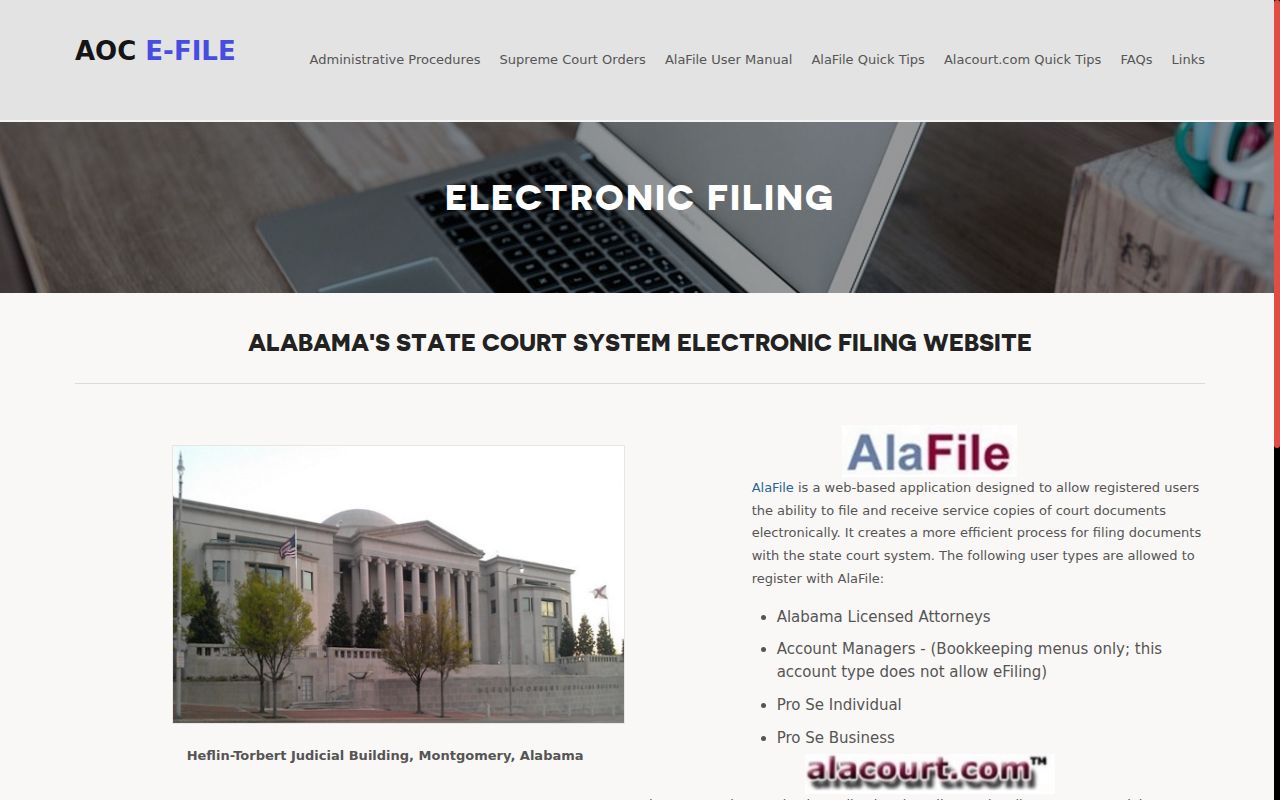
AlaFile serves registered filing users; it should not be mistaken for a free public search of every Alabama court record.
What Alabama Court Records Show
A typical Alabama case header identifies the county, court, case number, style, category, filing date, assigned judge, and current status. Party sections name plaintiffs, defendants, petitioners, respondents, the State, and attorneys as applicable. The event history records filings, service, answers, motions, settings, continuances, orders, pleas, trial activity, judgment, sentence, and appeal. Public financial entries may show court costs, fines, restitution, payments, or a balance, but they do not prove that no separate agency debt exists.
- Case number
- Alabama trial numbers commonly combine a county or court code, filing year, case-type letters such as CV, CC, DC, DR, SM, TR, JU, or CS, and a sequence.
- Docket
- The dated index of case events. It points to activity but is not a substitute for the signed order.
- Disposition
- The way a case or individual count ended, such as dismissal, acquittal, plea, verdict, transfer, or other final action.
- Document image
- A scanned pleading or order available to authorized paid access when imaged and not confidential.
Read every count separately. One arrest can lead to several charges, and each may have its own plea and disposition. A pending charge is an accusation, not proof of guilt. A docket marked closed can still have later post-judgment or appeal activity.
Alabama Statewide Record Systems
Several important Alabama records are held by state agencies rather than a court clerk. The Alabama Department of Corrections locator covers current state prisoners, not county jail detainees. The Alabama Law Enforcement Agency maintains fingerprint-linked criminal history, driver records, crash reports, and the public sex-offender registry. The Alabama Department of Public Health issues statewide marriage and divorce certificates for covered years. Each product answers a different question and cannot replace the underlying judicial file.
The ALEA online services directory gathers official state law-enforcement products in one place.
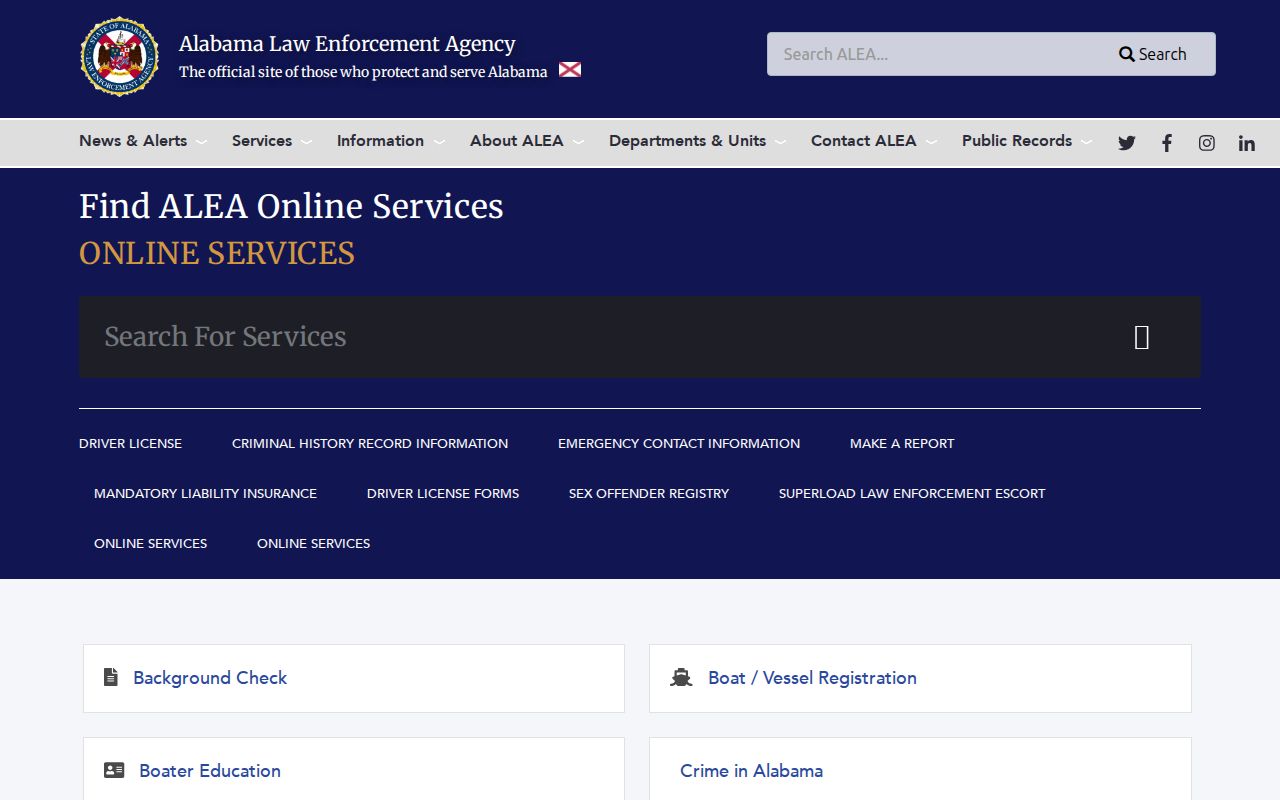
ALEA services are separate from the county Circuit Court record, even when both systems refer to the same incident.
| System | What It Holds | Run By |
|---|---|---|
| ADOC Inmate Search | Current state prisoners by six-digit AIS or name | Alabama Department of Corrections |
| ALEA Criminal History Repository | Fingerprint-linked arrests and reported dispositions | Alabama Law Enforcement Agency |
| ALEA Motor Vehicle Record | License status, reportable convictions, and administrative actions | ALEA Driver License Division |
| Center for Health Statistics | Marriage certificates from August 1936 and divorce certificates from 1950 | Alabama Department of Public Health |
| ALEA Sex Offender Registry | Publicly disseminable qualifying registration profiles | ALEA with local law-enforcement updates |
Use Alabama inmate records to distinguish county jail custody from state prison custody. Warrant checks still require county and city routes because Alabama has no verified comprehensive public statewide active-warrant portal.
The subscriber system offers deeper trial case access. Review the official Alacourt source for current account terms.
Subscriber access may provide details and images, while certified documents must still come from the court custodian.
Alabama Court Records Access Law
Alabama's general right to inspect and copy public writings appears in Ala. Code §36-12-40, subject to statutes and court rules that protect particular material. Judicial records also have their own access framework. Rule 30(I) of the Alabama Rules of Judicial Administration preserves free inspection of open court files, while allowing sealed, exempt, and restricted records to remain closed. Rule 33 confirms that electronic-data rules do not eliminate counter inspection and paid printing at the circuit clerk's office.
Key Statutes:
Ala. Code §36-12-40 gives citizens a general right to inspect and copy public writings, subject to legal exceptions.
Rule 30, Alabama Rules of Judicial Administration governs court-file inspection, copies, integrity, and restricted material.
Rule 33, Alabama Rules of Judicial Administration addresses electronic court data while preserving clerk-office access.
Alabama Court-Record Privacy Rules identify protected information and access procedures effective January 1, 2025.
A useful request names the county, case number, parties, date range, exact documents, and desired format. Inspection and copying are different. Looking at an open file is generally free, but copies, certification, archival research, retrieval, postage, and online access may cost money. Ask for an estimate and a written legal basis if material is withheld.
Restricted Alabama Court Records
Public access does not include every Alabama filing. Juvenile legal and social records are confidential under Ala. Code §12-15-133. Youthful Offender treatment is also protected and is not handled like an ordinary public conviction. Probate adoption files, original birth material tied to adoption, mental-health commitment records, protected medical detail, grand-jury material, and sealed pre-execution warrant affidavits have separate restrictions. Public copies must redact full Social Security numbers, financial accounts, protected minor and victim information, confidential addresses, and other material listed by the 2025 privacy rules.
Redaction and sealing are different. Redaction removes protected details from an otherwise public document; sealing blocks ordinary public access to the record or document. Alabama Chapter 27 supplies specific expungement routes for eligible criminal records. Eligibility depends on the charge, outcome, waiting rules, exclusions, and other statutory facts. A petition generally goes to the Circuit Court in the county tied to the charge, with notice to listed agencies. An order may restrict ordinary access but does not recall every private copy or eliminate all authorized criminal-justice use.
Find Alabama Court Records by County
Original Alabama trial records remain tied to the filing county even when judges serve a multi-county circuit. The county Circuit Clerk handles Circuit and District Court files. A municipal clerk holds city ordinance and municipal traffic matters, while the Probate Court keeps estates, guardianships, name changes, adoptions, and recorded marriage certificates. The six most populous counties below offer starting points for the largest metro searches, and every Alabama county has its own local records site.
Jefferson County
Birmingham · Alabama's largest circuit-court and county-jail search demand
Mobile County
Mobile · Major Circuit and District system with a separate Probate Court
Madison County
Huntsville · Fast-growing metro with high state and federal court demand
Baldwin County
Bay Minette · Growing coastal county with several court-service locations
Montgomery County
Montgomery · State capital, UJS headquarters, and Middle District venue
Shelby County
Columbiana · Large Birmingham-metro Circuit and District caseload
Browse the full directory of all 67 Alabama counties to open the court records site for any filing county.
Alabama Court Records Fees
Rule 30 protects free inspection of an open court file, but it does not make copies, certification, clerk research, archive retrieval, postage, or electronic subscriptions free. Court filing totals also combine statewide statutory distributions with local charges, service, and party-specific costs. Ask the filing clerk for a dated written schedule instead of relying on one statewide total. A verified substantial-hardship affidavit can request relief from prepayment, but a judge decides, costs may later be assessed, and outside expenses are not automatically waived.
- ADPH marriage or divorce search
- $15 includes the first certified copy or a failure-to-find certificate; simultaneous same-record copies are $6, and expedited service adds $15 where offered.
- ALEA personal criminal history
- $25 with fingerprints and identification, plus $5 for each additional copy requested together.
- ALEA driver record
- $5.75 through the official online or Driver License Office channel, plus any disclosed processing charge.
- ALEA crash report
- $15 for an eligible requester under the crash-report access rules.
Eligible state traffic tickets and criminal fines can be handled through AlaPay, but payment can operate as a plea and not every court or case status is payable online.
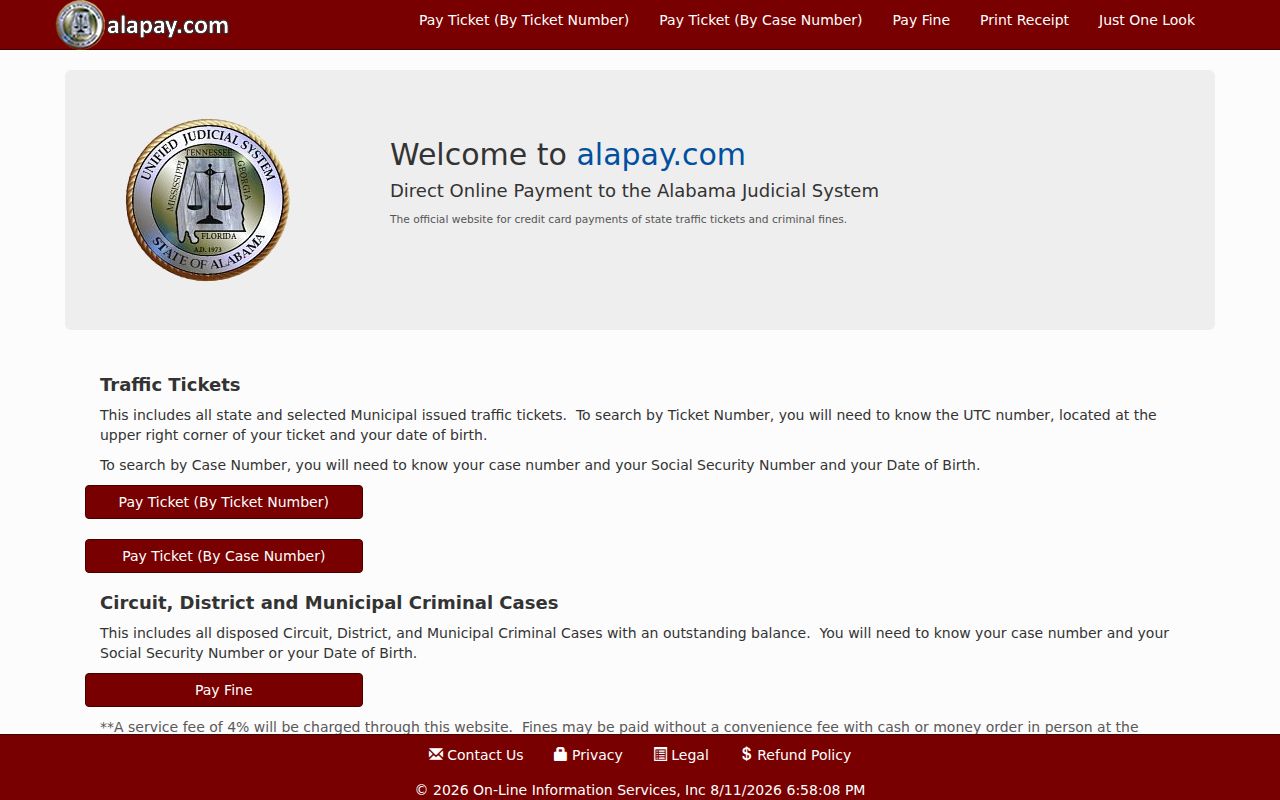
The portal displays the obligation and payment terms for supported cases; keep the confirmation and verify that the court docket updated.
Interpret Alabama Court Records
Read Alabama court records in time order and distinguish the allegation from the result. An indictment is a grand jury accusation, not a finding of guilt. Nolle prosequi means the prosecutor chose not to continue that charge at that time. A no bill means the grand jury declined to indict on the submission. Dismissal, acquittal, plea, and conviction as amended each have different meanings. The written judgment or sentence controls when an online summary and a signed order appear inconsistent.
Case status also needs context. Pending or open means the case has not reached final disposition. Transferred may point to a second county or higher court file. Appealed creates connected trial and appellate dockets. A zero balance does not establish that another agency has no debt, and bond is security for release rather than a fine. For a time-sensitive hearing, warrant, or last-minute filing, contact the clerk because no universal refresh interval is promised.
Verify Alabama Court Record Results
An online Alabama result can be incomplete without being confidential. Older files may exist only in an index, bound book, archive, or paper jacket. A public docket may show that an order was filed while the image remains unavailable. Municipal and probate offices also use separate local systems. If no result appears, check spelling, former names, case category, filing county, city venue, probate custody, and approximate year before concluding that no record exists.
For an indexing or identity error, save the case number and contact the custodian. The clerk can explain the authorized correction process but cannot erase an accurate record informally. A missing disposition in ALEA criminal history calls for a certified court result and the ALEA review or challenge process. Bulk Alabama court data is controlled through prescribed AOC programs, and unauthorized scraping or resale is not a substitute for official access.
Note: Confirm names, dates, court, county, and final disposition with the circuit clerk before relying on an Alabama online result.
Alabama Court Records Questions
Can one free site search every Alabama court?
No. Just One Look and Alacourt provide broad paid state trial access. The free appellate portal covers appellate cases, not the trial files below them. Municipal and probate systems remain separate, and confidential or older paper material may not appear online. Identify the venue, use the matching system, and then ask the correct clerk for source documents.
Why does the Circuit Clerk hold District Court records?
Alabama uses one elected county Circuit Clerk for both Circuit and District Court files. The name does not mean District Court has a second elected district clerk. Municipal clerks and probate offices remain separate custodians, so the subject and court name on the filing determine where the record belongs.
Does a dismissed Alabama case disappear?
Usually not. Dismissal is a disposition, and the docket can remain public. Alabama Chapter 27 creates expungement routes for eligible records, but the process requires a petition, notice, statutory eligibility, and a court order. Even then, authorized government access and private copies may remain under applicable law.
What proves the latest Alabama court result?
The signed order or judgment is the controlling court document, with clerk certification when official proof is required. Other products answer narrower questions: ALEA criminal history compiles fingerprint events, ADOC shows current state prison custody, ALEA MVR shows driver status, and ADPH certificates prove covered marriage or divorce events.
How are old Alabama files requested?
Give the clerk the full case style, all known name variants, approximate year, court type, county, and case number if known. Ask which archive or index covers the period, what retrieval costs apply, and whether a docket sheet can be supplied first. That narrows the documents needed for copying or certification.