
Alabama Court Hierarchy
Alabama has a unified judicial system, but unified administration does not place every court record in one database. The Alabama Judicial System oversees the statewide framework. Circuit Clerks keep Circuit and District files by county. Municipal clerks maintain city cases, and elected probate judges maintain Probate Court files. Appellate dockets use a separate public portal.
The Supreme Court of Alabama sits at the top. Two intermediate courts divide appeals by subject, not geography. The Court of Civil Appeals handles domestic relations, workers' compensation, most agency appeals, and qualifying civil appeals. The Court of Criminal Appeals handles all criminal appeals and post-conviction matters. Alabama has no separate criminal court of last resort.
Common appeals path: District or Municipal Court › Circuit Court for a new trial › subject-matter appellate court › Supreme Court of Alabama by certiorari.
| Level | Alabama court | Main work | Number in Alabama |
|---|---|---|---|
| Last resort | Supreme Court of Alabama | Final state review, qualifying direct civil appeals, rulemaking | 1 court, 9 justices |
| Intermediate appeal | Court of Civil Appeals | Domestic relations, workers' compensation, agency and qualifying civil appeals | 1 court, 5 judges |
| Intermediate appeal | Court of Criminal Appeals | Criminal appeals, habeas and post-conviction writs | 1 court, 5 judges |
| General trial | Circuit Court | Felonies, divorce, larger civil cases, jury trials, de novo appeals | 41 circuits |
| Limited trial | District Court | Misdemeanors, small claims, limited civil, felony preliminaries | 1 district per county |
| Local trial | Municipal Court | Municipal ordinances and many city traffic cases | Created by municipalities |
| County venue | Probate Court | Estates, guardianships, conservatorships, name changes and marriage recording | 1 elected probate judge per county |
Alabama Supreme Court Review
The nine-member Supreme Court of Alabama is the final state court. It hears civil appeals above the statutory monetary line, Alabama Public Service Commission appeals, and petitions asking it to review either intermediate appellate court. It also adopts rules governing Alabama courts, while the Chief Justice has administrative authority over the unified system. A federal question may later reach the U.S. Supreme Court, but ordinary state-law review ends here.
The official Supreme Court history traces Alabama appellate review to the 1819 Constitution. Its first term convened at Cahawba in 1820, when circuit judges initially performed Supreme Court functions. The separate institution developed as state government matured.
The official Supreme Court history page provides a visual record of Alabama's highest court and its institutional development.
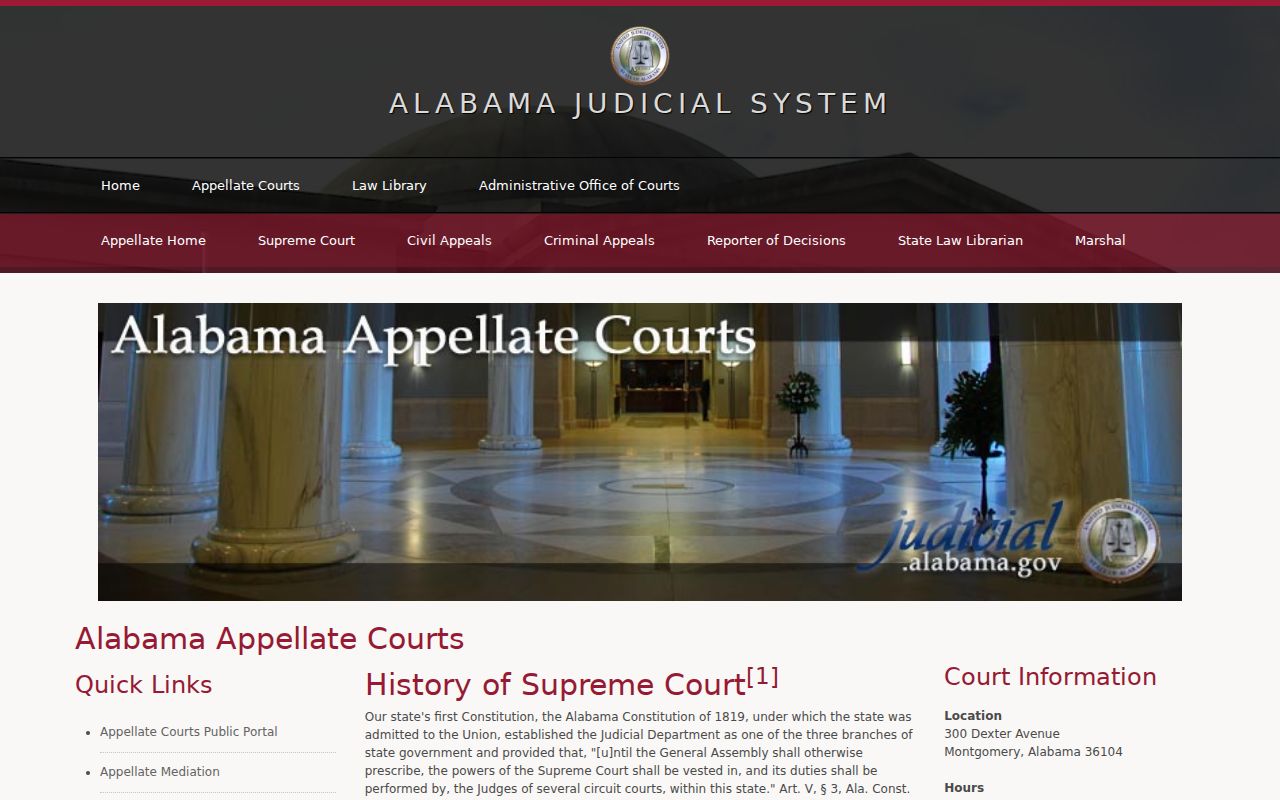
The image connects today's statewide hierarchy to Alabama's early circuit-based appellate structure.
Alabama Appellate Court Split
Alabama's two intermediate appellate courts are subject-matter courts. They are not appellate districts. The Court of Civil Appeals receives domestic-relations matters, workers' compensation cases, most administrative-agency appeals, and qualifying civil appeals. The Court of Criminal Appeals receives misdemeanor and felony appeals, habeas and post-conviction proceedings, and criminal remedial writs.
An appeal does not usually retry witnesses or accept a new set of facts. The appellate judges review the trial record, written briefs, and preserved legal issues. The county trial clerk prepares the record, while the appellate clerk opens a separate appellate docket containing briefs, submissions, orders, and opinions.
| Appellate court | Core jurisdiction | Next review |
|---|---|---|
| Court of Civil Appeals | Domestic relations, workers' compensation, most agency and qualifying civil cases | Supreme Court certiorari |
| Court of Criminal Appeals | All criminal appeals and criminal post-conviction writs | Supreme Court certiorari |
Note: Trial documents remain with the trial clerk even after an appellate docket is opened.
Alabama Circuit Court Records
Circuit Court is Alabama's general-jurisdiction trial court. The state has 41 judicial circuits covering all counties. One populous county may form a circuit, while several counties may share circuit judges. That shared judicial assignment does not merge the records. A case stays indexed by its filing county and case number, and that county's Circuit Clerk remains the ordinary custodian.
Circuit Courts hear felonies, divorce and other domestic-relations matters, larger civil claims, jury trials, and appeals tried anew from limited-jurisdiction courts. Current civil jurisdiction is governed by Alabama Code sections 12-11-30 and 12-12-30. Older official charts carry outdated thresholds, so the current Code and clerk should control a filing decision.
A transfer can create entries in both sending and receiving courts. Ask the sending clerk for the transfer order and the receiving clerk for the active file. A traveling judge's name alone does not identify the record location.
Alabama Trial Courts Compared
The document in hand often identifies the right Alabama venue. An indictment or Circuit case number points to Circuit Court. A small-claims statement or district criminal complaint points to the Circuit Clerk acting for District Court. A city citation points to Municipal Court, while a will or guardianship petition points to Probate Court.
| Feature | Circuit | District | Municipal | Probate |
|---|---|---|---|---|
| Criminal work | Felonies | Misdemeanors and felony preliminaries | Ordinance and city traffic violations | Not a general criminal venue |
| Civil or family work | Larger civil and domestic relations | Limited civil and small claims | Not ordinary civil litigation | Estates and protective proceedings |
| Record custodian | Circuit Clerk | Circuit Clerk | Municipal clerk | Probate judge or office |
| Ordinary appeal | Subject appellate court | Circuit trial de novo | Circuit trial de novo | Route varies by matter and local law |
Alabama Appeals Paths
Most Alabama cases end at trial. A Circuit case commonly moves from the initiating complaint, indictment, or petition to service or appearance, scheduling, discovery, trial or negotiated resolution, final judgment, post-judgment motion, and notice of appeal. The record then moves to the appellate court assigned by subject.
Civil record review: Circuit Court › Court of Civil Appeals or Supreme Court under statutory allocation › Supreme Court certiorari where applicable.
Criminal record review: Circuit Court › Court of Criminal Appeals › Supreme Court certiorari.
Lower-court new trial: District or Municipal Court › Circuit Court trial de novo › subject-matter appellate court.
A trial de novo is a new trial, not a narrow review of the lower docket for legal error. It creates a Circuit Court record that may contain the operative final result.
Alabama Specialized Court Programs
Alabama problem-solving programs operate within existing court jurisdiction. Certified or local programs include adult and juvenile drug courts, mental-health courts, veterans courts, family-treatment courts, and pretrial diversion. These programs do not form another statewide tier. Clinical, juvenile, and diversion materials can remain confidential even when a public docket notes participation.
The state also has a developing structure for complex commercial litigation. New filings should be checked against current legislation, court rules, and venue directions because program assignments and effective procedures can change.
Alabama Lower Court Venues
District Court exists in every county and handles misdemeanors, felony preliminary matters, small claims, limited civil cases, and state traffic where the matter is not municipal. Juvenile jurisdiction is exercised through court arrangements rather than a separate statewide courthouse tier. Public access can still be limited when juvenile facts are involved.
Municipal Courts are created by cities and hear ordinance violations within municipal police jurisdiction, including many traffic citations. They do not conduct jury trials. Probate Court is a separate county venue led by an elected probate judge. Its core records include estates, wills, guardianships, conservatorships, name changes, marriage certificates, and restricted adoption matters.
Federal Courts in Alabama
Federal cases do not appear in Alacourt. Alabama has Northern, Middle, and Southern U.S. District Courts. Each district also has a separate Bankruptcy Court. Appeals from Alabama federal courts go to the Eleventh Circuit.
Use the official district's county and division information for venue. PACER provides federal docket access after registration, and its nationwide locator can help when the district is unknown. PACER records are distinct from Alabama trial and appellate records.
Find Alabama Trial Courts
Start with the county where the matter was filed or the event occurred, not the subject's current home. The directory of all 67 Alabama counties routes to the local Circuit Clerk for Circuit and District files, Probate Office for probate and marriage records, Municipal Clerk for city cases, and sheriff for jail or warrant records. Use the case number whenever possible and confirm whether the requested copy must be certified.