
How to Search Alabama Court Records
The Alabama Administrative Office of Courts offers two broad trial-court products. Alacourt is read-only subscription access to state trial-court details and available images. Just One Look provides paid, one-case-at-a-time access. Both cover Alabama Circuit and District Court data in civil, domestic, criminal, and traffic categories. Neither is a universal public archive. Municipal dockets, Probate Court files, sealed matters, and some older paper or non-imaged documents require another channel. AlaFile is an electronic filing system for registered users, not a free public case search.
Start with a complete party name, former names, the filing county, an approximate year, and the case type. A case number is the best key because common names can produce unrelated results. Felonies, divorces, and larger civil cases usually point to Circuit Court. District Court handles misdemeanors, small claims, and other limited matters. A city citation points to its Municipal Court, while wills and guardianships point to Probate Court. Alabama's unified system does not merge these custodians.
- Open Alacourt or Just One Look for an Alabama state trial case. Use the separate appellate portal for Supreme Court or intermediate appellate matters.
- Search by case number when possible. Otherwise, try full and variant names, then narrow by county, court, category, and date.
- Confirm the court, county, party role, and filing date before opening a paid result. A matching name alone does not establish identity.
- Read events in order and locate the signed final order, judgment, or sentence. A filing or charge is not a final result.
- Ask the correct Circuit Clerk, municipal clerk, Probate Court, or appellate clerk for missing images, archival files, or certified copies.
A failed portal search is not proof that no Alabama court record exists. Check spelling, suffixes, business-name variants, adjacent case categories, and older archives. For a transferred case, obtain the transfer order from the sending clerk and the active file from the receiving clerk. Time-sensitive hearing, warrant, or protection-order information should be confirmed directly with the responsible court.
Alabama Court Records Search Fields
Just One Look is registration and payment gated, so controls may change after login. Official descriptions establish name and case-number searching with court, county, and category context. The table identifies the documented Alabama trial-record controls rather than promising that every account view looks identical.
| Field Label | Type | Required | Notes / Format |
|---|---|---|---|
| Username or email | Text | Yes after account setup | Account credential for paid access |
| Password | Password | Yes | Authenticates the registered user |
| Name search | Text | One search key | Try legal and former names; verify identity |
| Case number | Text | One search key | Most precise key, with county and case-type coding |
| Court or county | Filter | Context dependent | Confirms the Alabama trial court and venue |
| Case category | Filter or result | No | Civil, Domestic, Criminal, or Traffic |
Appellate searching works differently. The official appellate clerk route leads to a free portal that searches Case Number, Case Title, Case Category, and Filed Date. Newer Alabama appellate numbers use prefixes such as SC, CL, and CR. The appellate file contains briefs, orders, and opinions, while the filing county retains the underlying trial record.
Types of Alabama Court Records
Alabama court records reflect the jurisdiction that heard the dispute. A county Circuit Clerk keeps both Circuit and District Court files, despite the office's name. Municipal clerks keep city ordinance and municipal traffic cases. Probate judges maintain estates, guardianships, name changes, and marriage-certificate recordings. The appellate clerk maintains a separate docket after an appeal begins. Knowing the record type prevents a request from reaching the wrong office.
Civil discovery exchanged between parties is not automatically part of the public file. Likewise, a police arrest report is not the same as the court's criminal case. A divorce certificate confirms the event, but the Circuit Court decree contains the terms. The main Alabama court record groups include:
- Civil: complaints, service, answers, motions, orders, judgments, garnishments, and appeals in Circuit or District Court.
- Criminal: complaints, indictments, bond events, pleas, motions, verdicts, sentences, and post-conviction filings.
- Domestic relations: divorce, custody, support, paternity, and protection-from-abuse proceedings in Circuit Court.
- Traffic: citations, pleas, payments, warrants, and dispositions in Municipal, District, or Circuit Court.
- Probate: estate, will, guardianship, conservatorship, name-change, and marriage-recording files kept outside the Circuit Clerk's portfolio.
- Appellate: notices, briefs, submissions, orders, and opinions before Alabama's appellate courts.
Juvenile, adoption, mental-health, and Youthful Offender matters have strong access limits. A public docket reference does not make protected reports or exhibits available. Request only the public portion and ask the custodian to identify the authority for any restriction.
What Alabama Court Records Show
An Alabama case record begins with the court, county, case style, category, filing date, judge, and status. Its docket then tracks filed pleadings, service, hearings, orders, and disposition. Criminal files may add the charge, plea, bond, sentence, and costs. Civil files may show judgment and collection activity. The signed order controls when a short portal label is unclear.
| Field | What It Shows |
|---|---|
| Case number | Identifies the county, court context, filing year, case type, and sequence. |
| Filing date and category | Shows when the action began and whether it is civil, domestic, criminal, traffic, or another type. |
| Parties and attorneys | Names plaintiffs, defendants, petitioners, respondents, the State, and counsel, subject to redaction. |
| Docket events | Lists filings, service returns, settings, motions, pleas, continuances, orders, and appeal notices. |
| Status | May read pending, disposed, appealed, transferred, stayed, inactive, or another system label. |
| Disposition | States how the case or charge ended; consult the signed order for complete terms. |
| Financial entries | May show fines, costs, restitution, or payments but not every separate agency debt. |
| Document image | Provides an available pleading or order; absence may mean paper, archive, or restricted status. |
Common Alabama case-type codes include CV, CC, DC, DR, SM, TR, JU, and CS. Codes help locate a file, but they do not prove guilt or identity. A docket is metadata. A certified copy of the judgment, sentence, or other signed order is the stronger record when an agency or another court needs proof.
Public Access to Alabama Court Records
Ala. Code §36-12-40 supplies Alabama's general right to inspect and copy public writings, subject to exceptions. For judicial files, Rule 30 of the Alabama Rules of Judicial Administration is more direct. Rule 30(I) keeps open court files available for free inspection unless they are sealed, exempt, restricted, or otherwise closed. Rule 33 preserves clerk-counter inspection while regulating access to Alabama electronic court data.
Inspection does not make every service free. A Circuit Clerk may charge for copies, certification, permitted searches, archive retrieval, postage, or authentication. Filing and service totals also vary by county and case. Ask for a written estimate and distinguish a plain copy from a certified or exemplified copy. Rule 30(F) permits, but does not require, a clerk to perform a broad background or archival search. A narrow request should name the case, county, year, and exact docketed documents.
Note: Free inspection of an open Alabama file does not include free copying, certification, research, postage, or archive retrieval.
Restricted Alabama Court Records
The Alabama Rules of Court-Record Privacy and Confidentiality, effective January 1, 2025, organize statewide standards for protected judicial information. Juvenile legal and social records, Youthful Offender matters, adoption files, mental-health commitment material, grand-jury proceedings, some pretrial-diversion communications, and sealed warrant affidavits are not ordinary public records. Filers and courts must also protect Social Security numbers, financial accounts, minor and victim information, confidential addresses, and medical details.
Redaction and sealing are not the same. A redacted Alabama court document remains public with protected details removed. Sealing blocks ordinary public access to the document or case. A person seeking sealed content may need standing, statutory authority, consent, or a court order. Invoking the public-writings law alone does not override the restriction. Ask whether a segregable, redacted public portion can be released.
Alabama criminal-record expungement follows Ala. Code Chapter 27. Eligibility depends on the exact charge, outcome, waiting period, exclusions, completed sentence, and other statutory facts. A sworn petition is filed in the proper Circuit Court with required records, notice, and costs or approved hardship papers. If granted, the clerk distributes the order to named agencies. A dismissal by itself normally remains a docket disposition, and a pardon does not automatically erase the case.
The Alabama Judicial System maintains an official court rules and amendments index for current statewide authority.
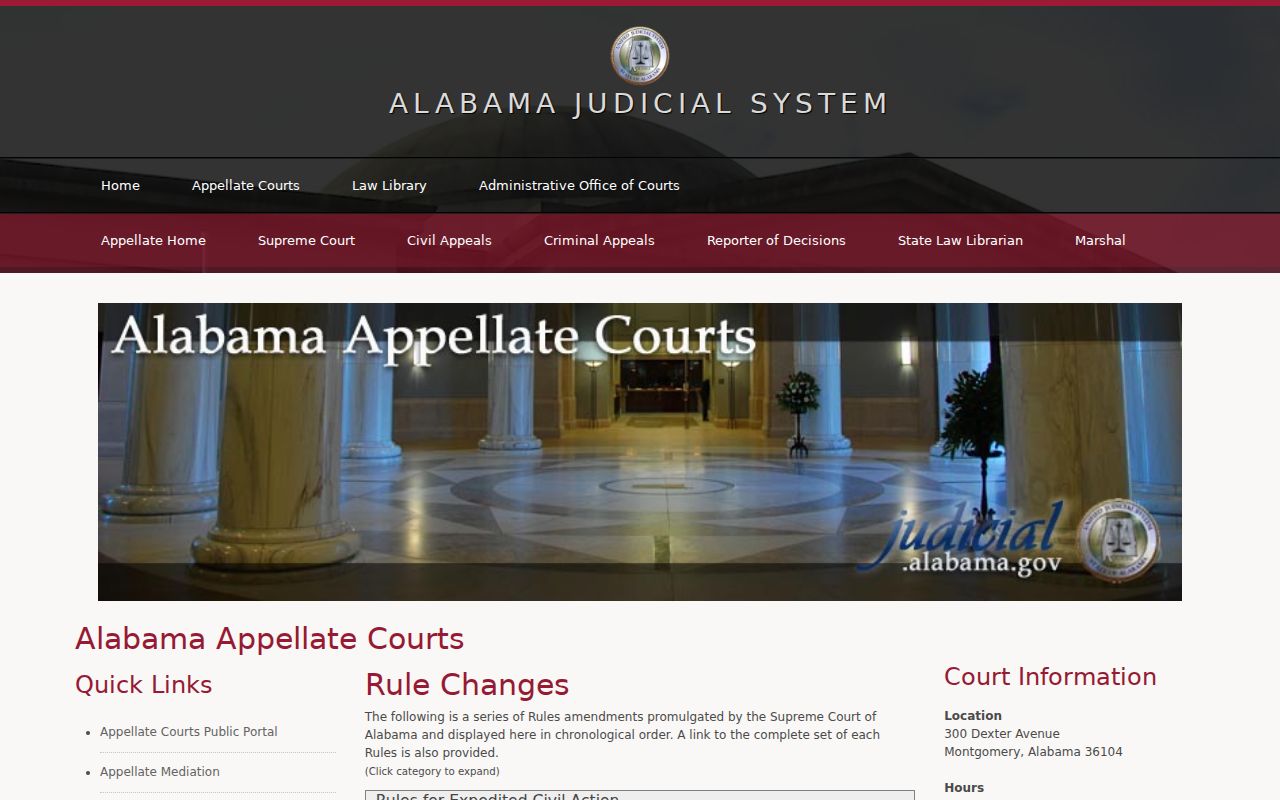
The index helps readers verify rule changes before relying on an older Alabama court-record access or filing summary.
Find Alabama Court Records Offices
Alabama has one Circuit Clerk in each county, and that office keeps both Circuit and District Court records. There is no separate elected “district clerk.” Municipal clerks remain responsible for city ordinance and municipal traffic cases. Probate judges keep estate, guardianship, adoption, name-change, and marriage-recording files. The appellate clerk handles Supreme Court, Court of Civil Appeals, and Court of Criminal Appeals records.
Choose the county where the action was filed, not where a party now lives. The Alabama county directory routes to all 67 local court-record sites. Ask for online access, counter inspection, mail or other written-copy service, and archival retrieval where relevant. Provide the case number, full style, year, court division, document title, and whether certification is needed. Confirm current hours, payment methods, and costs with the custodian before sending money.
Tip: Start with filing county and court type, then request the docket sheet before ordering selected Alabama court documents.