
Alabama Arrest Records and Charges
Alabama arrest records are agency records of an arrest or booking. They can identify the subject, arresting agency, booking date and number, initial allegations, and bond or custody status. A police incident report may add investigative facts, but it can be withheld or redacted while an investigation is active. Neither source is the court's final account.
Court charges after arrest begin when an accusation reaches the judicial system. A complaint may start District or Municipal proceedings. A grand-jury indictment usually moves a felony into Circuit Court. An authorized information has a narrower procedural role. The Circuit Clerk keeps Circuit and District court charge records; a municipal clerk keeps city cases. The district attorney prosecutes state offenses, while municipal prosecutors handle ordinances.
The same incident can produce five records: police report, booking record, prosecutor file, court case, and ALEA criminal history. They update at different times. A booking label can be broad or preliminary. The charging document and later court orders show what was actually filed, changed, or resolved.
Current booking and custody details belong in Alabama inmate records. Once a prosecution opens, the full plea, motion, disposition, and sentence trail appears in Alabama criminal court records.
Search Alabama Arrest Records
There is no single official public database that combines every Alabama arrest, booking, prosecutor decision, and court result. Search the county sheriff or city arresting agency for the booking or releasable incident report. Use Just One Look or Alacourt for paid state trial-case access. Contact the Circuit Clerk for filed Circuit or District documents and the municipal clerk for city cases.
- Identify the arrest location, agency, date, and complete legal name. Use a booking or case number when known.
- Check the official jail or agency channel for arrest and custody data, then search the correct Alabama court.
- Open the case and compare complaint or indictment counts with the booking allegations.
- Read each count's code, class, plea, amendment, and current disposition.
- Obtain the signed order from the clerk when the final result or certification matters.
A recent arrest may appear in a jail roster before a court case is indexed. A released or transferred person also may disappear from a current-only roster. For custody, use the local jail channel rather than assuming the Alabama Department of Corrections covers county bookings.

ADOC is the state-prison system for sentenced commitments, not an Alabama county arrest or booking database.
Alabama Charging Documents
Arrest can occur before or after a court issues process, but the judicial charge must rest on an authorized instrument. Alabama uses the following charging documents. None is a finding of guilt.
| Complaint | Information | Indictment | |
|---|---|---|---|
| Source | Sworn allegations supporting probable cause | Prosecutor-signed instrument where law and procedure permit | Formal accusation returned by a grand jury |
| Common role | Misdemeanor case or preliminary felony proceedings | Authorized proceedings, often tied to waiver procedure | Usual felony charging instrument in Circuit Court |
| Public limit | Victim and protected details may be redacted | Only the filed instrument is a court record | Indictment may be public, but evidence and voting remain secret |
A Uniform Traffic Ticket and Complaint can start many traffic cases. One arrest can produce several counts, and an indictment can supersede the complaint description. Report the original allegation and final count separately.
Read Alabama Charge Status
Each count can follow a different path. Read the status with the statute, description, offense date, plea, and final order. A broad case status can close one count while another linked matter remains open.
- Pending
- The count has no final disposition; it does not by itself prove an active warrant.
- Amended
- The filed allegation changed; compare original and final codes and descriptions.
- Bound over
- A felony matter moved toward grand-jury or Circuit Court action.
- No bill
- The grand jury declined to indict on the submission.
- Dismissed
- The pending count ended subject to the order's terms, but the docket can remain public.
- Nolle prosequi
- The prosecutor formally chose not to continue that charge at the time.
Alabama Charges vs. Convictions
An Alabama arrest or filed charge is not a conviction. A conviction requires a guilty plea or verdict and a judgment. Charges can be dismissed, no-billed, nolle prossed, amended, or end in acquittal. Those nonconviction outcomes may remain visible unless an expungement or another lawful restriction applies.
| Charge | Conviction | |
|---|---|---|
| Stage | Accusation | Verdict or plea |
| Meaning | Accusation filed through lawful process | Adjudication of guilt by plea or verdict |
| What proves it | Charging document and current docket | Signed judgment and sentencing order |
| Possible result | Amendment, dismissal, acquittal, or conviction | Sentence, post-judgment action, or appeal |
Bond is not a fine and does not predict guilt. One booking can show several bonds or a hold from another agency. Confirm release conditions with the issuing court and current custody with the jail.
Sealed and Expunged Alabama Charges
A sealed record is hidden from ordinary public access under a rule or order. Alabama Chapter 27 expungement is a separate statutory process for eligible charges and a limited class of convictions. Eligibility turns on the exact offense, disposition, exclusions, completed obligations, waiting periods, and other facts. The person files a sworn petition in the proper Circuit Court with certified records, notices, and required costs or approved hardship papers.
| Sealed | Expunged | |
|---|---|---|
| Public visibility | Blocked as the rule or order directs | Removed or segregated from ordinary access under Chapter 27 |
| Official access | Authorized access can remain | Limited criminal-justice and statutory access can remain |
| Basis | Confidentiality authority or court order | Eligibility, petition, notice, and judicial order |
| Private copies | Not automatically recalled | Not automatically erased from news or private archives |
An order must identify affected agencies so the clerk can distribute it. ALEA implementation may lag. A pardon does not automatically erase an Alabama arrest record or court charge record.
Alabama Charge Codes and Classes
Read the code beside the description, count, offense date, class, and amended disposition. Alabama grades felonies as Classes A through D and misdemeanors as Classes A through C, but offense statutes and enhancements control. A class alone cannot safely predict sentence. Municipal ordinances and traffic charges can use other codes and custodians.
District Court handles misdemeanors and felony preliminary events. Circuit Court has felony jurisdiction after indictment or another authorized path. A case may begin with a District complaint and later receive a Circuit case number. Preserve both numbers when requesting the full trail.
Alabama Statewide Charge History
The ALEA Criminal Records Identification Unit maintains fingerprint-linked criminal history compiled from contributing arrest and disposition records. An individual requests a personal review or challenge with fingerprints, valid photo identification, and a $25 payment, plus $5 for each simultaneous additional copy. This CHRI can find multi-county events, but it does not contain every pleading or signed order.
The reporting chain can break when fingerprints, aliases, or disposition data do not match. If CHRI lacks a final result, obtain the certified court disposition and follow ALEA's challenge directions. “No disposition” can be a reporting gap, not proof the charge is still pending. Keep the report secure because it contains sensitive identity data.
Using Alabama Arrest Records
Formal consumer background checks used for employment, housing, credit, insurance, or another regulated purpose must follow the Fair Credit Reporting Act, including permissible-purpose and adverse-action duties. Casual access to a public docket does not create a compliant consumer report. Qualifying employers may use ALEA's secure employer system under its own eligibility and consent requirements; the public may not pose as a subscriber.
Important: These records are not a consumer report and may not be used for an FCRA-regulated employment, credit, or housing decision.
Alabama's judicial administration is headed by the Chief Justice, but that office is not the custodian of county charge files. The official Chief Justice biography illustrates the state-level administrative role.
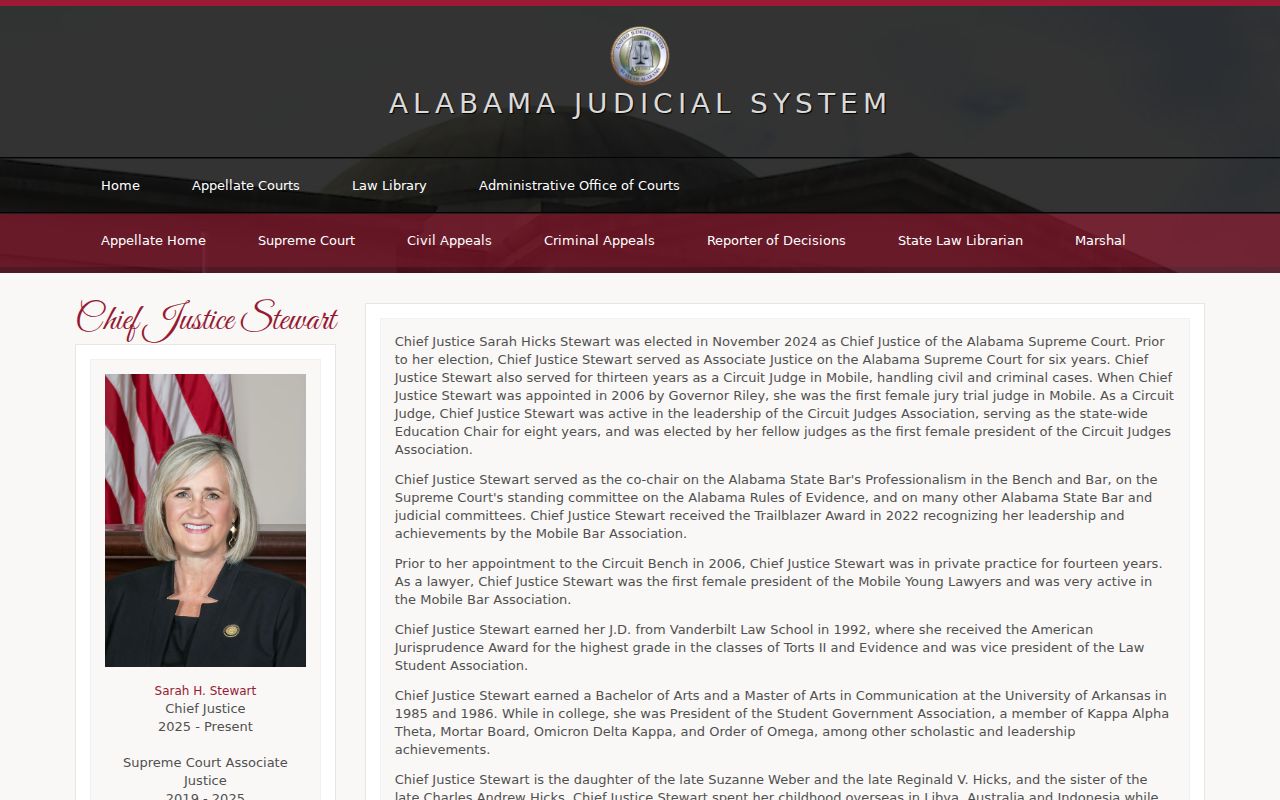
Requests for Alabama arrest records and court charges still go to the arresting agency, jail, Circuit Clerk, or municipal clerk that holds them.
Restricted Alabama Charge Records
Juvenile legal and social records are confidential under Ala. Code §12-15-133. Youthful Offender treatment is also protected. Grand-jury proceedings, active investigative material, victim and minor details, full identifiers, medical information, and sealed warrant affidavits may be withheld. A public case entry does not make every attachment open.
The Alabama Rules of Court-Record Privacy and Confidentiality, effective January 1, 2025, organize redaction and access standards. Redaction leaves a public document with protected facts removed. Sealing blocks ordinary access. If a custodian withholds a record, ask for the governing statute, rule, or order and any segregable public portion.
Use the Alabama county directory to select where the arrest or charge occurred. Ask the sheriff or police agency for the releasable arrest record, the Circuit Clerk for Circuit or District charges, and the municipal clerk for city cases. Provide the full name, event date, agency, booking or case number, document requested, and whether certification is needed.
Note: A missing web result is not proof of no Alabama arrest, charge, warrant, or sealed proceeding.